
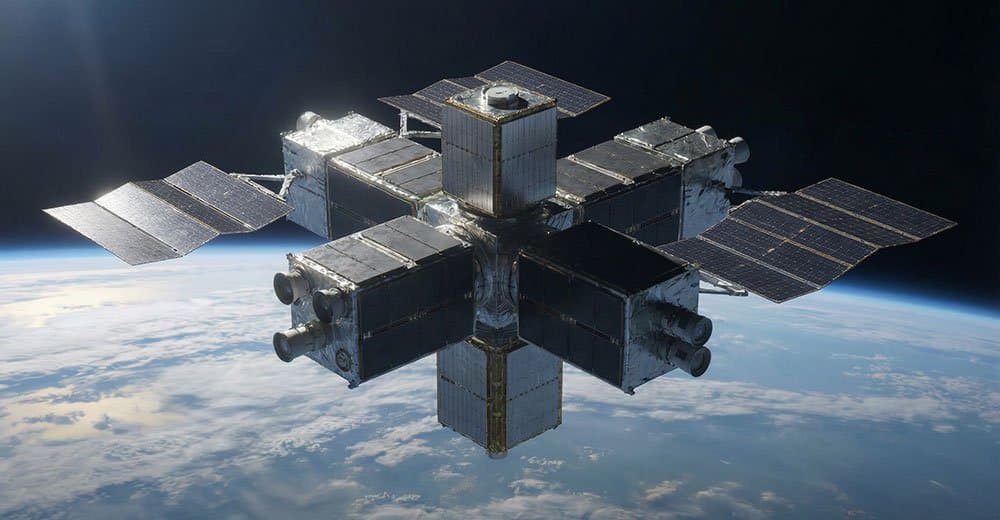
**Major technology firms and startups are racing to overcome terrestrial energy and cooling limits for AI training and inference by shifting large language model workloads to orbital platforms.** Starcloud demonstrated the concept in November 2025 with a single NVIDIA H100 GPU that trained a small LLM in orbit, while SpaceX, Blue Origin, Orbital, and Sophia Space have filed for constellations ranging from tens of thousands to one million satellites, citing unlimited solar power and passive radiative cooling in vacuum. However, these remain filings and prototypes; no qualifying orbital data center with at least 100 data-center-grade accelerators has launched as of September 2026. Key upcoming catalysts include 2027 prototype missions from Google’s Project Suncatcher, SpaceX’s AI1 designs, and Sophia Space’s TILE modules, alongside pending FCC approvals and launch-cost reductions needed for commercial scale. Trader sentiment reflects the gap between ambitious roadmaps and the engineering, regulatory, and economic hurdles still ahead.
Eksperymentalne podsumowanie AI odwołujące się do danych Polymarket. To nie jest porada handlowa i nie ma wpływu na rozstrzyganie tego rynku. · ZaktualizowanoAI data center in space by...?
AI data center in space by...?
$54,142 Wol.
December 31, 2026
2%
December 31, 2027
23%
$54,142 Wol.
December 31, 2026
2%
December 31, 2027
23%
“Orbital data center” refers to any spacecraft, satellite, or equivalent technology carrying computing infrastructure that is launched into Earth’s orbit for the purpose of providing data-center, cloud-computing, or artificial intelligence computing services and which includes at least 100 data-center-grade AI accelerators, GPUs, TPUs, or substantially equivalent compute processors, (e.g. NVIDIA H100 GPUs, Google TPUs, or equivalent or successor chips).
“Successfully launched” refers to any launch which successfully places a qualifying orbital data center into Earth’s orbit.
The primary resolution source for this market will be a consensus of credible reporting.
Rynek otwarty: May 14, 2026, 1:45 PM ET
Rozstrzygający
0x65070BE91...“Orbital data center” refers to any spacecraft, satellite, or equivalent technology carrying computing infrastructure that is launched into Earth’s orbit for the purpose of providing data-center, cloud-computing, or artificial intelligence computing services and which includes at least 100 data-center-grade AI accelerators, GPUs, TPUs, or substantially equivalent compute processors, (e.g. NVIDIA H100 GPUs, Google TPUs, or equivalent or successor chips).
“Successfully launched” refers to any launch which successfully places a qualifying orbital data center into Earth’s orbit.
The primary resolution source for this market will be a consensus of credible reporting.
Rozstrzygający
0x65070BE91...**Major technology firms and startups are racing to overcome terrestrial energy and cooling limits for AI training and inference by shifting large language model workloads to orbital platforms.** Starcloud demonstrated the concept in November 2025 with a single NVIDIA H100 GPU that trained a small LLM in orbit, while SpaceX, Blue Origin, Orbital, and Sophia Space have filed for constellations ranging from tens of thousands to one million satellites, citing unlimited solar power and passive radiative cooling in vacuum. However, these remain filings and prototypes; no qualifying orbital data center with at least 100 data-center-grade accelerators has launched as of September 2026. Key upcoming catalysts include 2027 prototype missions from Google’s Project Suncatcher, SpaceX’s AI1 designs, and Sophia Space’s TILE modules, alongside pending FCC approvals and launch-cost reductions needed for commercial scale. Trader sentiment reflects the gap between ambitious roadmaps and the engineering, regulatory, and economic hurdles still ahead.
Eksperymentalne podsumowanie AI odwołujące się do danych Polymarket. To nie jest porada handlowa i nie ma wpływu na rozstrzyganie tego rynku. · Zaktualizowano


Uważaj na linki zewnętrzne.
Uważaj na linki zewnętrzne.
Często zadawane pytania