
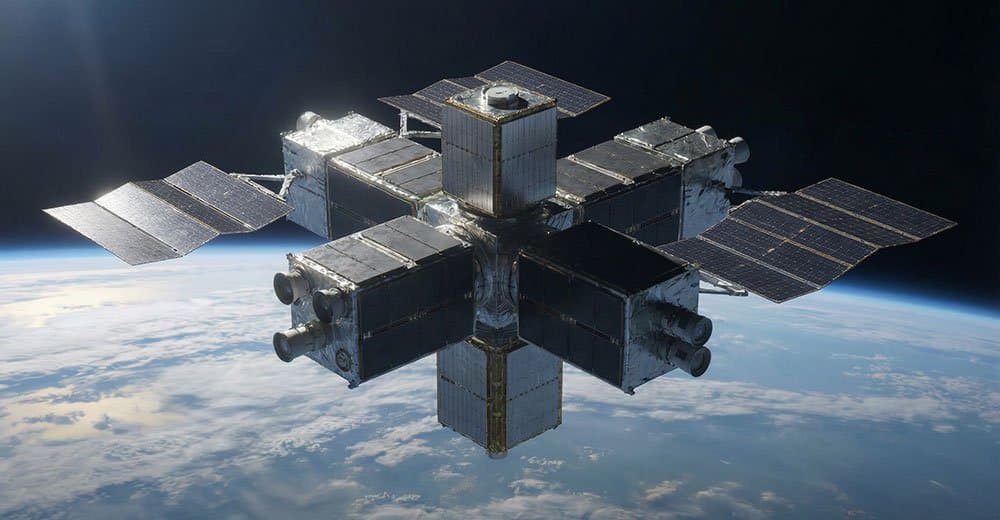
**Recent filings and small-scale orbital demonstrations have shaped trader sentiment around the low probability of a qualifying AI data center launching by late 2026 or 2027.** Starcloud’s November 2025 Starcloud-1 mission placed the first Nvidia H100 GPU in orbit, successfully training a small language model and running inference on models like Gemma, but this single-GPU payload falls short of the market’s 100-accelerator threshold. Major players including SpaceX (AI1 satellite design and FCC filing for up to one million satellites targeting 2028+ deployment), Google (Project Suncatcher prototypes with Planet Labs slated for early 2027), Blue Origin (Project Sunrise), and Starcloud (next multi-GPU satellite targeted for October 2026 and 88,000-satellite constellation plans) have advanced concepts leveraging solar power and radiation-hardened hardware. However, scaling to data-center-class clusters faces launch cadence, radiation, thermal, and regulatory hurdles, keeping near-term implied probabilities low while highlighting longer-term competitive momentum in orbital compute.
Tóm tắt AI thử nghiệm tham chiếu dữ liệu Polymarket. Đây không phải tư vấn giao dịch và không ảnh hưởng đến cách thị trường này được giải quyết. · Cập nhật$49,447 KL.
December 31, 2026
2%
December 31, 2027
17%
$49,447 KL.
December 31, 2026
2%
December 31, 2027
17%
“Orbital data center” refers to any spacecraft, satellite, or equivalent technology carrying computing infrastructure that is launched into Earth’s orbit for the purpose of providing data-center, cloud-computing, or artificial intelligence computing services and which includes at least 100 data-center-grade AI accelerators, GPUs, TPUs, or substantially equivalent compute processors, (e.g. NVIDIA H100 GPUs, Google TPUs, or equivalent or successor chips).
“Successfully launched” refers to any launch which successfully places a qualifying orbital data center into Earth’s orbit.
The primary resolution source for this market will be a consensus of credible reporting.
Thị trường mở: May 14, 2026, 1:45 PM ET
Người giải quyết
0x65070BE91...“Orbital data center” refers to any spacecraft, satellite, or equivalent technology carrying computing infrastructure that is launched into Earth’s orbit for the purpose of providing data-center, cloud-computing, or artificial intelligence computing services and which includes at least 100 data-center-grade AI accelerators, GPUs, TPUs, or substantially equivalent compute processors, (e.g. NVIDIA H100 GPUs, Google TPUs, or equivalent or successor chips).
“Successfully launched” refers to any launch which successfully places a qualifying orbital data center into Earth’s orbit.
The primary resolution source for this market will be a consensus of credible reporting.
Người giải quyết
0x65070BE91...**Recent filings and small-scale orbital demonstrations have shaped trader sentiment around the low probability of a qualifying AI data center launching by late 2026 or 2027.** Starcloud’s November 2025 Starcloud-1 mission placed the first Nvidia H100 GPU in orbit, successfully training a small language model and running inference on models like Gemma, but this single-GPU payload falls short of the market’s 100-accelerator threshold. Major players including SpaceX (AI1 satellite design and FCC filing for up to one million satellites targeting 2028+ deployment), Google (Project Suncatcher prototypes with Planet Labs slated for early 2027), Blue Origin (Project Sunrise), and Starcloud (next multi-GPU satellite targeted for October 2026 and 88,000-satellite constellation plans) have advanced concepts leveraging solar power and radiation-hardened hardware. However, scaling to data-center-class clusters faces launch cadence, radiation, thermal, and regulatory hurdles, keeping near-term implied probabilities low while highlighting longer-term competitive momentum in orbital compute.
Tóm tắt AI thử nghiệm tham chiếu dữ liệu Polymarket. Đây không phải tư vấn giao dịch và không ảnh hưởng đến cách thị trường này được giải quyết. · Cập nhật


Cẩn thận với liên kết bên ngoài.
Cẩn thận với liên kết bên ngoài.
Câu hỏi thường gặp