
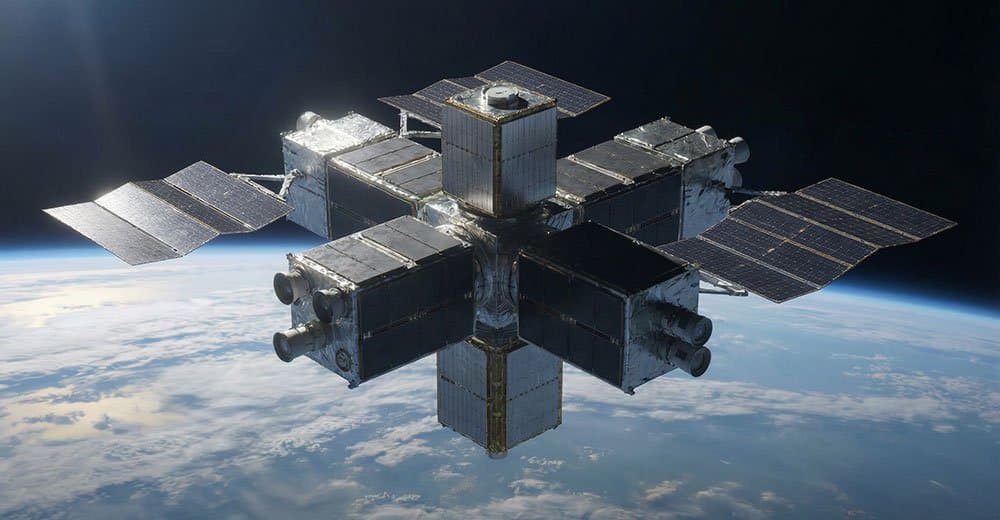
**Recent filings and small-scale orbital demonstrations have shaped trader sentiment around the low probability of a qualifying AI data center launching by late 2026 or 2027.** Starcloud’s November 2025 Starcloud-1 mission placed the first Nvidia H100 GPU in orbit, successfully training a small language model and running inference on models like Gemma, but this single-GPU payload falls short of the market’s 100-accelerator threshold. Major players including SpaceX (AI1 satellite design and FCC filing for up to one million satellites targeting 2028+ deployment), Google (Project Suncatcher prototypes with Planet Labs slated for early 2027), Blue Origin (Project Sunrise), and Starcloud (next multi-GPU satellite targeted for October 2026 and 88,000-satellite constellation plans) have advanced concepts leveraging solar power and radiation-hardened hardware. However, scaling to data-center-class clusters faces launch cadence, radiation, thermal, and regulatory hurdles, keeping near-term implied probabilities low while highlighting longer-term competitive momentum in orbital compute.
Résumé expérimental généré par IA à partir des données Polymarket. Ceci n'est pas un conseil de trading et ne joue aucun rôle dans la résolution de ce marché. · Mis à jour$49,447 Vol.
December 31, 2026
2%
December 31, 2027
17%
$49,447 Vol.
December 31, 2026
2%
December 31, 2027
17%
“Orbital data center” refers to any spacecraft, satellite, or equivalent technology carrying computing infrastructure that is launched into Earth’s orbit for the purpose of providing data-center, cloud-computing, or artificial intelligence computing services and which includes at least 100 data-center-grade AI accelerators, GPUs, TPUs, or substantially equivalent compute processors, (e.g. NVIDIA H100 GPUs, Google TPUs, or equivalent or successor chips).
“Successfully launched” refers to any launch which successfully places a qualifying orbital data center into Earth’s orbit.
The primary resolution source for this market will be a consensus of credible reporting.
Marché ouvert : May 14, 2026, 1:45 PM ET
Résolveur
0x65070BE91...“Orbital data center” refers to any spacecraft, satellite, or equivalent technology carrying computing infrastructure that is launched into Earth’s orbit for the purpose of providing data-center, cloud-computing, or artificial intelligence computing services and which includes at least 100 data-center-grade AI accelerators, GPUs, TPUs, or substantially equivalent compute processors, (e.g. NVIDIA H100 GPUs, Google TPUs, or equivalent or successor chips).
“Successfully launched” refers to any launch which successfully places a qualifying orbital data center into Earth’s orbit.
The primary resolution source for this market will be a consensus of credible reporting.
Résolveur
0x65070BE91...**Recent filings and small-scale orbital demonstrations have shaped trader sentiment around the low probability of a qualifying AI data center launching by late 2026 or 2027.** Starcloud’s November 2025 Starcloud-1 mission placed the first Nvidia H100 GPU in orbit, successfully training a small language model and running inference on models like Gemma, but this single-GPU payload falls short of the market’s 100-accelerator threshold. Major players including SpaceX (AI1 satellite design and FCC filing for up to one million satellites targeting 2028+ deployment), Google (Project Suncatcher prototypes with Planet Labs slated for early 2027), Blue Origin (Project Sunrise), and Starcloud (next multi-GPU satellite targeted for October 2026 and 88,000-satellite constellation plans) have advanced concepts leveraging solar power and radiation-hardened hardware. However, scaling to data-center-class clusters faces launch cadence, radiation, thermal, and regulatory hurdles, keeping near-term implied probabilities low while highlighting longer-term competitive momentum in orbital compute.
Résumé expérimental généré par IA à partir des données Polymarket. Ceci n'est pas un conseil de trading et ne joue aucun rôle dans la résolution de ce marché. · Mis à jour


Méfiez-vous des liens externes.
Méfiez-vous des liens externes.
Questions fréquentes